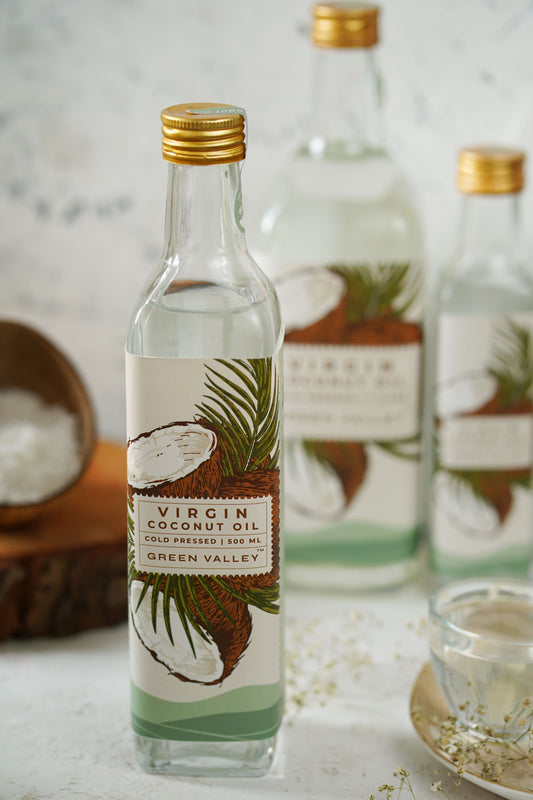

Coconut oil and heat have a long relationship. In kitchens, they work side by side. In beauty routines, they often meet again when someone warms a spoonful of oil before a hair massage. The question is simple but important:
Does heating coconut oil damage it? And if it does, are you quietly undoing the very benefits you are trying to gain?
What Makes Coconut Oil “Good” For Hair?
Coconut oil’s hair benefits are primarily attributed to its fatty acid profile. It is composed of about 90 per cent saturated fats, predominantly medium-chain fatty acids. The most important of these is lauric acid.
Lauric acid has:
- A low molecular weight
- A straight-chain structure
- Strong affinity for hair proteins
Coconut oil reduces protein loss in both damaged and undamaged hair when used as a pre-wash or post-wash treatment. Unlike many oils that sit only on the surface, coconut oil can penetrate the hair shaft and interact with internal structures.
That penetration is what gives it structural value.
What Happens When You Heat Coconut Oil?
Coconut oil melts at around 24 to 26°C. That means in many climates, it turns from solid to liquid simply by sitting on a warm shelf. This phase change does not damage it. Melting is not degradation. It is simply a physical shift.
The concern arises when coconut oil is heated to higher temperatures.
There are two important thresholds to understand:
1. Gentle Warming (Below 100°C)
If you warm coconut oil by placing the jar in hot water or briefly microwaving it until just melted, you are not destroying its beneficial fatty acids.
Saturated fats, which dominate coconut oil, are relatively stable compared to polyunsaturated fats. They resist oxidation better. This is one reason coconut oil has a relatively long shelf life.
At gentle warming temperatures, the molecular structure remains intact. Lauric acid does not break down under mild heat.
Conclusion: Light warming does not destroy its beneficial properties.
2. Between 100°C and 175°C
Coconut oil is composed primarily of saturated fatty acids, especially lauric acid. Saturated fats are structurally stable because they lack double bonds, which are typically the weak points where oxidation begins.
- The oil is not yet smoking.
- Fatty acids do not rapidly decompose.
- There is no large-scale thermal breakdown.
- The oil has not reached major structural degradation.
2. High Heat (Above 175°C, Near Smoke Point)
Coconut oil has a smoke point of around 175°C. Refined coconut oil can go higher, around 200 to 230°C.
When oils reach their smoke point:
- Fatty acids begin to oxidize.
- Free radicals may form.
- Beneficial compounds like antioxidants degrade.
Repeated heating accelerates this degradation. Studies in food chemistry show that prolonged high heat can reduce antioxidant capacity and increase oxidative byproducts in oils.
If you were repeatedly heating coconut oil to frying temperatures and then applying it to your hair, degradation would be a legitimate concern.
However, this is not how hair oiling is typically done.
Does Heating Improve Its Hair Benefits?
Some believe warming coconut oil makes it “more potent.” That is not chemically accurate.
What warming does is improve spreadability.
When liquefied:
- It distributes more evenly across strands.
- It penetrates more easily into porous hair.
- It coats the scalp more uniformly.
Heat increases molecular movement, which may slightly improve absorption into the hair shaft. But the oil itself does not become more beneficial. It simply becomes easier to work with.
There is also the psychological component. Warm oil massages increase blood flow to the scalp. Improved circulation may support scalp health, but that is due to massage and warmth, not chemical enhancement of the oil.
What About Microwaving Coconut Oil?
Brief microwaving to melt solid oil is generally safe. The risk arises if:
- You overheat it to very high temperatures.
- You heat it repeatedly over time.
- You expose it to prolonged direct heat.
Excessive heat can lead to oxidation, which alters the oil’s fatty acid structure. Oxidized oil is less stable and potentially irritating to the scalp.
If you microwave coconut oil:
- Use short bursts of 5 to 10 seconds.
- Stop once it liquefies.
- Avoid letting it smoke.
Smoke is the warning signal.
Does Heating Destroy Antioxidants?
Coconut oil contains small amounts of polyphenols and vitamin E, which contribute antioxidant activity.
These compounds are more sensitive to heat than saturated fats. High temperatures can reduce antioxidant levels.
However, in cosmetic use:
- The heating is typically mild.
- Exposure time is short.
- The oil is not repeatedly reheated like cooking oil in commercial fryers.
Under these conditions, antioxidant degradation is minimal.
When Heating Might Be A Bad Idea
There are scenarios where heating coconut oil is not beneficial:
- If the oil smells rancid after heating.
- If it smokes visibly.
- If it has been stored improperly and repeatedly reheated.
- If you are mixing it with heat-sensitive essential oils, which can degrade more quickly.
Additionally, applying very hot oil directly to the scalp can cause burns. The oil should feel warm, not hot.
Is Cold-Pressed Better If You Heat It?
Cold-pressed or virgin coconut oil retains more natural compounds compared to refined versions. These include trace antioxidants and phytonutrients.
If you gently warm cold-pressed oil, you still preserve most of its beneficial fatty acid structure.
However, if you frequently heat it to high temperatures, you negate the advantage of choosing an unrefined version in the first place.
Moderation is the deciding factor.
The Practical Recommendation
If your goal is to use coconut oil for hair:
- Warm it gently.
- Avoid high temperatures.
- Do not repeatedly reheat the same batch.
- Store it in a cool, dark place to prevent oxidation.
From a biochemical standpoint, coconut oil is relatively heat-stable compared to many other plant oils. Its saturated fat composition gives it resilience.
But resilience is not immunity.