
Walk into a supermarket, and you'll find coconut oil labelled in several different ways: virgin, extra virgin, organic, cold pressed, refined, unrefined, and more.
For someone trying to choose a minimally processed coconut oil, the term "cold pressed" can be particularly appealing. But what does it actually mean, and how can you tell whether a coconut oil is genuinely cold pressed?
The answer isn't always visible from the oil itself. The most reliable clues come from the label, manufacturing information, and the manufacturer's transparency.
What does cold-pressed coconut oil mean?
Cold-pressing refers to an extraction method.
In simple terms, the oil is mechanically extracted from the coconut without deliberately applying high heat as part of the extraction process.
The process can involve crushing, pressing, or other mechanical methods to separate the oil from the coconut material.
The exact production process varies between manufacturers, so "cold-pressed" should not be treated as a single universal production method.
The important distinction is that the oil is extracted mechanically rather than relying on chemical solvents to extract the oil.
Is cold-pressed the same as virgin coconut oil?
No. The terms describe different characteristics. Cold pressed generally refers to the method used to extract the oil.
Virgin coconut oil refers to coconut oil produced from fresh coconut material rather than dried coconut, with relatively minimal processing. A product may therefore be described as virgin and cold pressed, but the two terms are not interchangeable.
This distinction is useful when reading labels because it prevents you from assuming that one term automatically guarantees the other.
Check the ingredient list
One of the easiest places to start is the ingredient list. For a pure coconut oil, you would generally expect the ingredient list to simply identify coconut oil or the relevant coconut-derived oil.
Be cautious of products containing unnecessary additives, fragrances, or other ingredients if your goal is a pure cooking oil. The front of the package can contain marketing language, but the ingredient list and mandatory product information provide more useful clues.
Look for specific production information
A trustworthy manufacturer should be able to explain how its oil is produced.
Look for information such as:
- Whether fresh or dried coconuts are used
- How the oil is extracted
- Whether heat is used during processing
- Whether chemical solvents are involved
- Whether the oil is filtered or refined
- Where the coconuts are sourced
If a brand makes a specific cold-pressed claim but provides no information about its production process, you may want to investigate further. A manufacturer's website can be particularly useful because it may provide more detail than the bottle label.
Does cold-pressed coconut oil look different?
Not necessarily. Virgin coconut oil can appear clear and liquid when warm and white and solid when cooler. The texture changes because coconut oil naturally solidifies at temperatures below roughly 24°C.
This means that appearance alone is not a reliable way to determine whether an oil is cold pressed. A clear liquid oil isn't necessarily more processed, and a white solid oil isn't necessarily less processed. Temperature can explain the difference.
What about the smell?
Virgin coconut oil often has a characteristic coconut aroma, particularly when it has undergone minimal processing. A strong or mild aroma, however, does not independently prove that an oil is cold pressed.
Refined coconut oil is generally more neutral in smell and taste because it undergoes additional processing. So aroma can provide a useful clue about the type of coconut oil you're buying, but it isn't a definitive authentication test.
Does cold-pressed mean healthier?
Not automatically. Cold pressing describes how oil is extracted, not a guarantee about its overall nutritional or health effects.
Coconut oil remains high in saturated fat regardless of whether it is cold pressed or refined. The advantage of choosing a cold-pressed virgin coconut oil is primarily that it can retain the natural characteristics and nutritional profiles of the coconut and involve less intensive processing that may reduce these characteristics. Your overall dietary pattern still matters more than a single processing label.
What does "chemical free" mean?
You'll sometimes see coconut oil marketed as "chemical free." This wording can be misleading because everything, including coconut and water, consists of chemicals.
A more useful question is whether the oil was extracted using chemical solvents. If you're looking for mechanically extracted coconut oil, check whether the manufacturer clearly states that the oil is mechanically or cold pressed and whether solvents are used during extraction. Clear terminology is a sign of better product transparency.
What certifications should you look for?
Depending on the product and market, certifications can provide additional information about quality systems or production standards.
You may see certifications relating to:
- Food safety management
- Organic production
- Manufacturing practices
- Quality management
However, a certification should be relevant to the claim being made. An organic certification, for example, addresses organic production standards. It doesn't automatically prove that the oil was cold pressed. Always check what a particular certification actually covers.
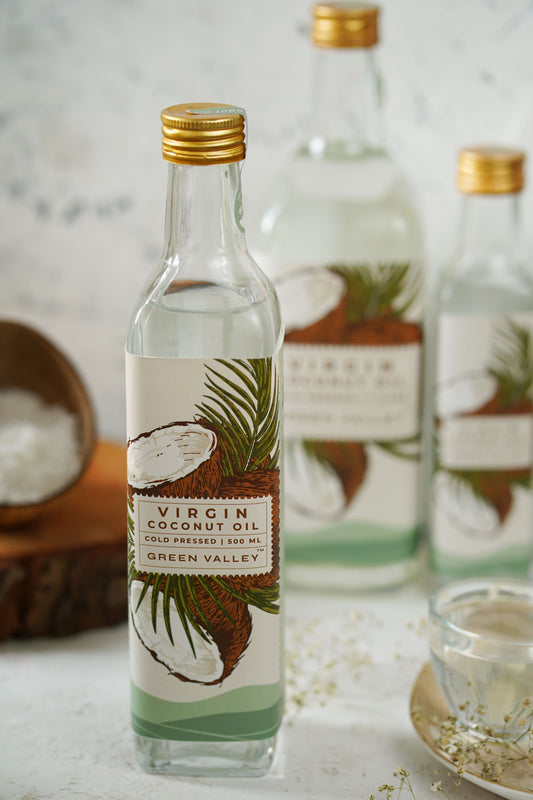
How Green Valley makes its virgin coconut oil
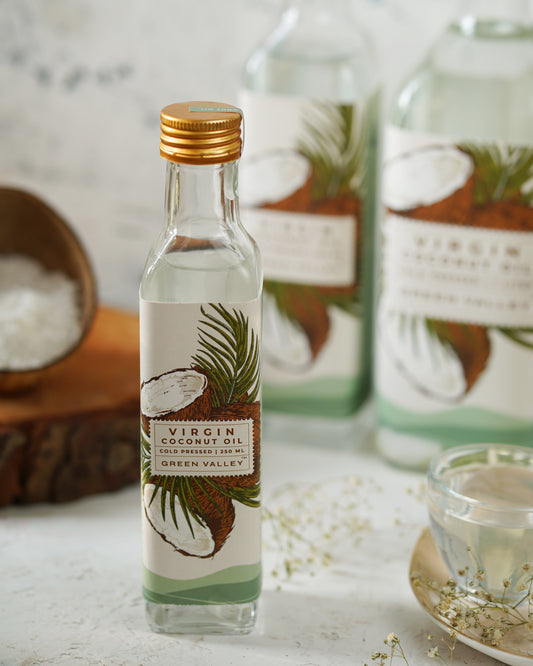
Green Valley Virgin Coconut Oil is cold pressed from fresh coconuts without the use of chemicals. The focus is on maintaining the natural characteristics of the coconut while avoiding unnecessary processing. This gives the oil its characteristic aroma and flavour and makes it suitable for cooking and other household applications. When evaluating any coconut oil, including Green Valley's, consumers should look beyond attractive front-of-pack claims and consider the complete product information.
Final thoughts
The easiest way to identify genuinely cold-pressed coconut oil isn't to rely on colour, texture, or smell. Read the label, investigate the production process, and choose manufacturers that are transparent about how their oil is made.
And remember that "cold pressed" and "virgin" aren't synonyms. Understanding the difference makes it much easier to compare products and choose a coconut oil that matches your preferences.
A good bottle shouldn't need a detective novel to explain what's inside it.